
 Online Business Development
 Quality Management
 Environmental Management
 Health & Safety Management
 Information Security Management
 IT Services Management
 Food Safety
 Medical Laboratories
 Design courses
 ICDL
 Cisco
 IT Security
 CompTIA
 Programing
 crafts
 Safety
 Office Management
 Human Resource Management
 Institutional Development
 RedHat
 Public Relations
 Anti - Bribery Management System
 Traffic Safety Management System
 Purchases & Warehouses
 Leadership Development
 ERP System
 Accounting
 International storing and distribution practice
 Blacksmithing
 carpentry
 Building and Industrial Electrical
 Fashion Stylist and Model Making
 Aluminum carpentry
 Automobile Diagnostic
 Modern Male’s Hairdressing
 Modern Pastry
 International Cuisine
 Caregiver
 Computer programming
 graphic design
 Bodybuilding, Fitness Hit Training
 Accounting and Management
 Plumbing and Air conditioning
 Mobile phone repair and maintenance
 Babysitter
 Office Computer Skills
 Modern Butchery
 Welding
 Plumping
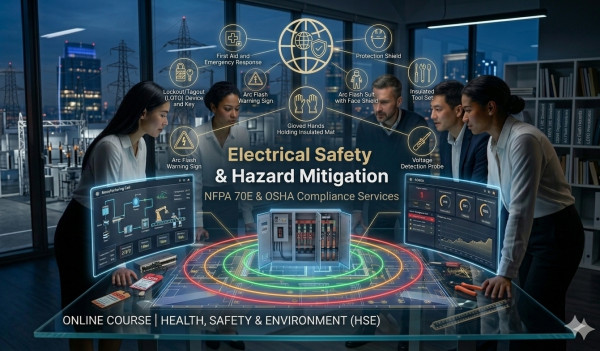
Electrical Safety & NFPA 70EBuilding and Industrial Electrical / Electrical Safety & NFPA 70E
| Location : Online |
who should attend?
• Facility managers, safety officers, and HSE professionals responsible for workplace compliance
• Electrical engineers, field technicians, and maintenance personnel working on energized systems
• Plant supervisors and industrial contractors who manage tasks with high electrical risk exposure
• Anyone looking to understand risk assessment methodologies and regulatory safety standards
objective
• Identify electrical hazards in the workplace and implement appropriate mitigation controls
• Establish an electrically safe work condition (LOTO) in accordance with NFPA 70E standards
• Determine shock boundaries, arc flash boundaries, and select compliant personal protective equipment
• Create comprehensive electrical safety programs, task assessments, and emergency response procedures
content
• Introduction to electrical safety: Hazards of shock, electrocution, arc flash, and arc blast
• Understanding regulatory frameworks: Overview of OSHA regulations and the structure of NFPA 70E
• Establishing safe work conditions: Principles of Lockout/Tagout (LOTO) and zero-energy verification
• Risk assessment methodologies: Estimating likelihood and severity of electrical injury for specific tasks
• Protection boundaries and distances: Calculating approach boundaries for shock and arc flash exposure
• Personal Protective Equipment (PPE): Selecting arc-rated clothing, insulated tools, and safety gear
• Safety requirements for special equipment: Batteries, lasers, power electronic systems, and sub-stations
• Capstone exercise: Developing an electrical safety program and analyzing real-world accident case studies